



How To Become Dangerously Productive (Complete Plan)

You are already Productive.
You proved it this morning when you reached for your phone before getting off your bed. You proved it when you opened the app you swore you were done with. You proved it every time you chose the easy distraction over the work you should be doing.
The problem is not that you are not productive. The problem is that your productivity is pointed in the wrong direction. And until you understand why, no amount of planning will save you.
So today we are going to get to the root cause of the problem. How can you become more productive that it makes you Dangerous.
First you need to understand this.
Productivity Is A Loop
Everything in the universe runs on cause and effect. Hegel called it the dialectic. It simply means a thesis meets antithesis, and over time, you get synthesis. A new reality.

I know you are already asking; Tolu what does this have to do with anything? Just trust me I am going somewhere with this.
Here is a simple example.
Let's say you are broke, that is your thesis, your current reality. Then you start a business or you get a job or become a freelancer. That is the antithesis, the cause. When those two come together within a time period you get a new reality: you become financially stable. That is the synthesis.
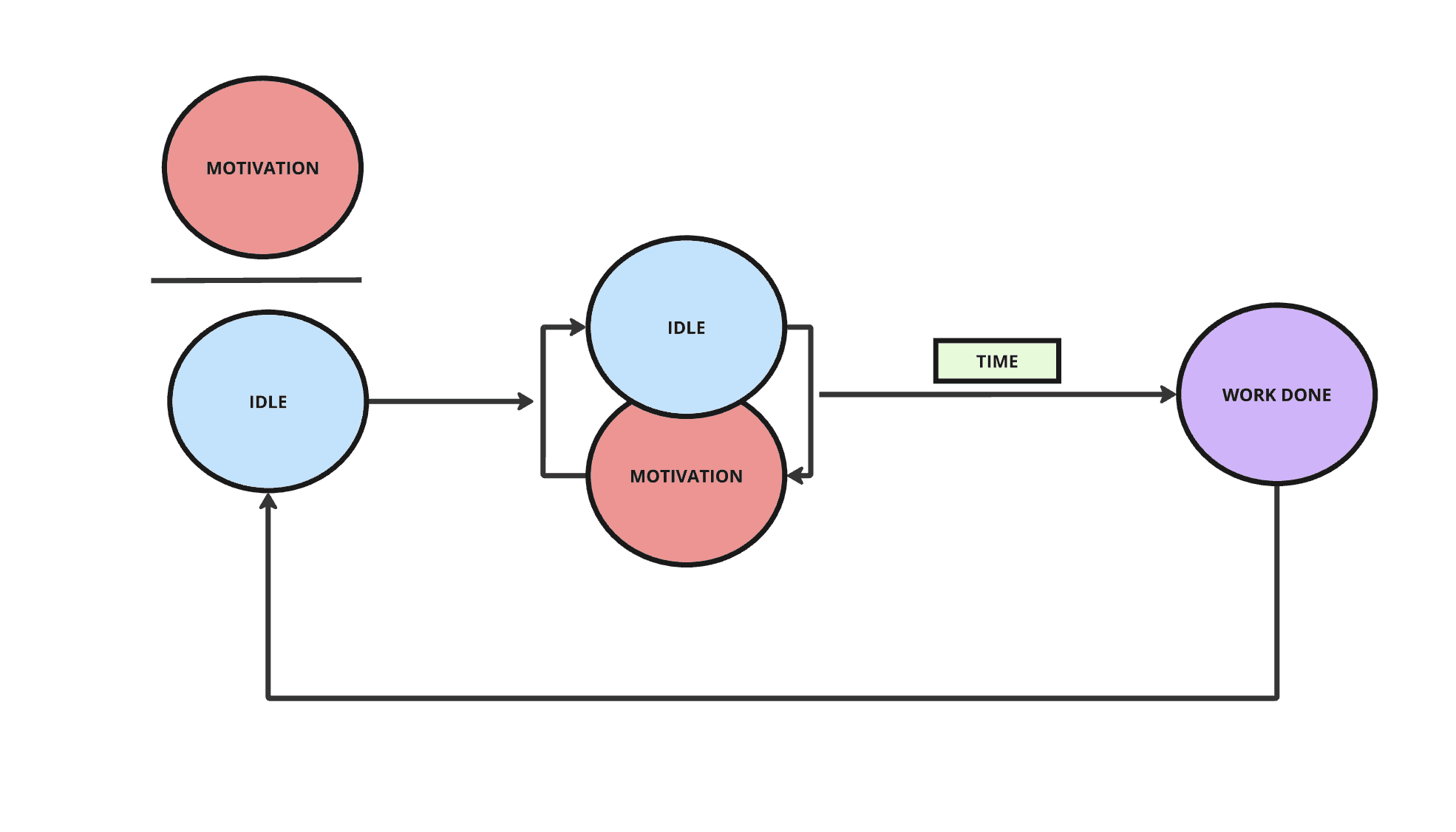
Productivity works the same way.
Your thesis is being idle. You are not doing anything. The antithesis is motivation. When those two meet, within moments you are on a task, being productive. And then it loops.
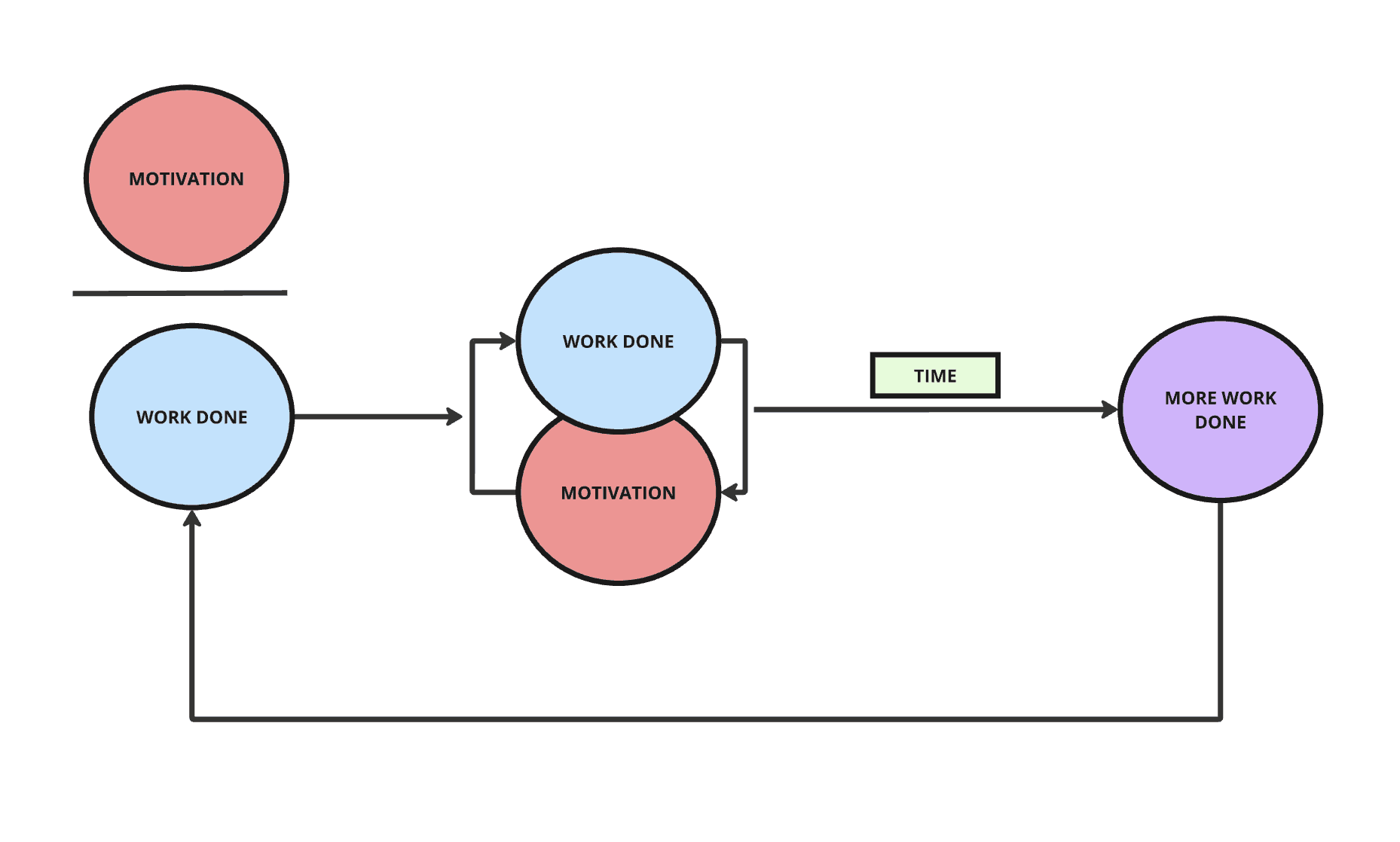
Now work becomes the new thesis, you get more motivation, and with time you get even more done. By the end of the day you can say you had a productive day.
I need you to understand this because I strongly believe you can only solve a problem at the depth in which you understand the problem.
If productivity is a loop that means you get motivated, do the work, get more motivated, do more work then you cannot leave motivation to chance the way you have been doing.
Where you are right now, idle and waiting for motivation to strike, that is the reason you are not productive. Which brings us to the real question. If motivation is the spark that starts the loop, how do you make sure it shows up every single time?
The Science Of Motivation
You are motivated all the time, just not in the direction you want it to be.
When you wake up in the morning, the first thing you probably do is pick up your phone. I know because this is me too. You wake up, pick up your phone, try to catch up with notifications, check who liked your post and who didn't, and you end up scrolling for hours before starting your day.
And if your focus is completely fragmented, which I hope isn't the case, while you work you would unconsciously pick up your phone just to check something without even thinking about it. Why? Because it feels good to do it, you aren't even sure why. It feels so good that it is now a habit.
If we can be motivated to do something that doesn't help us in any way without thinking about it, we should be able to set up our motivation for work in a way that runs on autopilot as well.
The key to making this happen is one word: dopamine.
Now you have probably heard of the term before, that feel-good chemical that is secreted by the brain to reward you for doing something that preserves you or keeps you alive.
Of course big tech companies have found ways to hijack this system for their profits through social media platforms, video games, etc. That is why when you wake up in the morning the first thing you do is pick up your phone.
The reason it works is because they have found a way to make their products feel like you are taking action toward preserving your survival. This is why scrolling feels like progress when in reality it isn't. Or you can sit and play video games for hours because for a brief moment you are a character and that character is making progress in the game.
Motivation on autopilot means the work itself has to trigger dopamine. Your brain needs to read the act of working as progress worth repeating. That is what we want to achieve. But how do we actually do this?
If dopamine is the reward signal for perceived progress, and tech companies have weaponized that signal against you, then you need to design your environment and your life so that the work itself triggers the same reward loop.
That means three things.
1) Create A Vision
Remember the dopamine loop we just talked about. Your brain rewards you when it perceives progress toward a target. But here is the catch: if there is no target, there is no progress signal. And if there is no progress signal, there is no dopamine. Your brain has nothing to reward you for, so it looks elsewhere. Your phone. Your notifications. Anything that feels like forward motion.
This is why clarity is the foundation of automatic motivation. When I say you can only solve a problem at the depth in which you understand the problem, what I mean is simple: you need clarity.
Everything starts and ends with clarity, and it is no different with motivation. If you are not clear about where you are headed, then what is the use of motivation? What is the force that would pull you to get up and work anyway?
You need to have a clear vision of who or what you want to become. Now, notice I did not say set a goal. Goals can change depending on your situation, depending on where you are in life. In fact, I believe goals are for short-term bursts of work. You can have a goal to read 50 books in 365 days, and that works. But that does not mean you will have that same goal the next 365 days. You might want to read 100 books next.
So rather than set goals that can change and should change as you walk through life, define the vision you have for your life first.
While trying to define this vision, imagine it in detail.
How much does this person have? Where does this person live? Where is this person emotionally? What business does this person operate? Is this person married? What is this person's physique? The more detailed you are, the better.
Now I can already hear you murmur: Tolu, I don't know what I want out of life. I don't have any vision. I am just lost.
Well, that is music to my ears. Because if you do not know what you want, I am sure you know what you do not want.
I call this an Anti-Vision.
The beauty of an Anti-Vision is that you do not have to look too far to find it. Just look around you. Assess how you grew up. What financial habits did your parents have that did not make sense? How was your childhood? How was your parents' marriage? Did someone around you pay zero attention to their health and suffered severely for it at the prime of their life?
I believe living life just means not knowing where you are headed but moving regardless, simply to escape the life you do not want. If you are not sure of what you want out of life, then start with an Anti-Vision and make the opposite end of the spectrum your vision.
And once you have that on lock, you can move to step two.
2) Have A Plan
At this point, if you are actively working through each step, which I hope you are, you should either have a clear vision of what you want out of life or a clear vision of what you do not want out of life. Either one works fine, but it is not enough.
You need a plan that will lead you to the life you want.
Here is how you create that plan.
1) Set a goal for the next 5 years.
Based on the vision you have for yourself, what do you need to achieve in the next 5 years to be a couple of steps closer to actualizing that vision? To make it easy, ensure the goals fit into these three buckets: a financial goal, a goal for your mind (knowledge, skill, career, etc.), and finally a goal for your health.
Grab a notebook, your journal, whatever you use to think on paper, and write them down.
Once you have done that, move to the next step.
2) Break your goals down
You do not rise to the level of your goals, you fall to the level of your systems. The goals you have set for 5 years need to translate to daily tasks that become habits. That is the only way you get clarity.
From five years, break it down to one year. Then six months. Then three months, this month, this week, all the way down to the task you have today.
If you do this correctly, the tasks you do today lead to achieving this week's goals, which leads up to this month's goal, that adds up to your goals for the next quarter, and so on.
Fast forward to five years from now, a large chunk of your goals achieved and probably surpassed, and it would all lead back to the tasks you do tomorrow.
Now once you have this all planned out, you move on to step 3.
3) Design Your Life
I used to think having a plan was enough. I would sit down, map out my week, break down my goals, and feel like I had everything figured out then Monday morning would come and I would pick up my phone first thing in the morning and guess what my whole day is ruined
Here is what took me too long to understand. For you to stay motivated your environment needs to be designed in a way that makes work seamless.
Your environment is always making decisions for you. The phone on your desk has already decided you will check it. The cluttered room has already decided you will feel scattered. The friend who always calls at 10 AM has already decided you will not get that deep work session in. You can have the clearest vision and the most detailed plan, but if your surroundings are working against you, you are going to lose.
You need to understand that the path to work is full of friction and the path to distraction is smooth and your brain, chasing dopamine the way we talked about, will take the smooth path every time.
So you have to reverse it.
Make the work easy to start and the distractions hard to reach. That is it. That is the fundamentals of designing your life so you become productive.
For me, that meant a few specific changes. My phone charges in another room when I am working. Not because I have superhuman discipline. Because I know myself. If it is within reach, I will pick it up. So I stopped pretending I would not. I removed the option.
My workspace has nothing on it except what I need for the work. If I have to clear a space before I can start, I have already created a moment of hesitation. And hesitation is where the loop breaks.
The point is not to copy my setup. The point is to look at your own life and ask one question: what is between me and the work? Then remove it. That is it
Because the thing is motivation does not come from wanting it more. It comes from designing your world so that the work is the path of least resistance. When the environment does the pulling, you stop needing to push.
That is the whole game. A clear target. A plan that points at it. And an environment that makes the work easier to do than to avoid. Get those three things right, and motivation stops being something you chase and becomes something that just happens.
That will be all for today, If this was helpful don't forget to let me know by either liking, commenting or sharing this with someone.
Enjoy the rest of your day and remember, I am rooting for you. 🎈
Tolu.